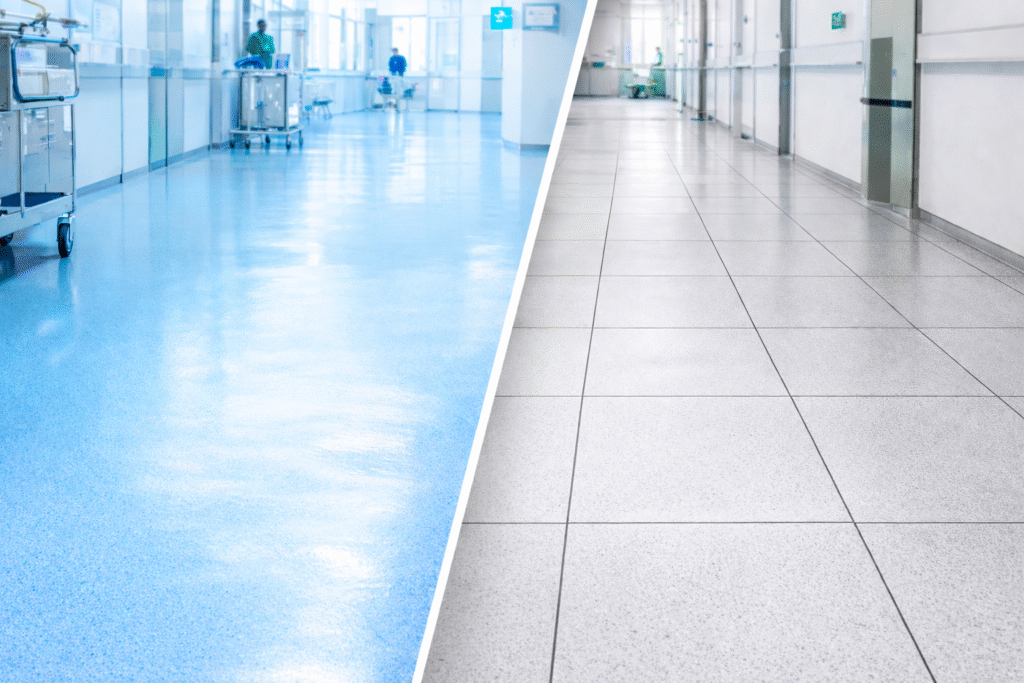
Hospitals require flooring systems that offer the highest standards of hygiene, safety, and durability. Every surface in a healthcare environment must support infection control, allow easy cleaning, and withstand constant use. However, modern healthcare facilities are increasingly shifting toward self-levelling epoxy flooring due to its seamless structure and superior performance.
Unlike tile floors, which consist of multiple pieces joined together with grout, self-levelling epoxy flooring forms a continuous, joint-free surface. This seamless finish improves cleanliness, reduces maintenance, and enhances durability, making it an ideal flooring system for hospitals, laboratories, and healthcare facilities.
What is Self-Levelling Epoxy Flooring?
Self-levelling epoxy flooring is a high-performance flooring product made by blending epoxy resin with a hardener. When the epoxy resin is poured over a concrete floor, the product will spread evenly and cover the floor smoothly. After the epoxy resin is cured, the flooring will be a seamless and strong coating that is resistant to chemicals, abrasion, and heavy foot traffic.
As a result of the product’s high performance and ability to resist chemicals and abrasion, epoxy resin flooring is commonly used in environments where hygiene is critical. Hospitals, pharmaceutical plants, and laboratories are environments where epoxy resin flooring is commonly used due to the product’s ability to provide a high level of hygiene.
Another significant advantage of seamless epoxy floors is their ability to create a uniform and visually clean surface, as there are no joints or grout lines.
Tile Flooring in Hospitals
Tile flooring has been used in hospitals for a long time because of its affordability and availability. Tiles can be easily installed using adhesives. The tiles can be finished by leaving grout joints between each tile. Even though tile flooring can be structured, it has many grout joints on the flooring.
In hospitals, grout joints can be a place where dust, moisture, and bacteria can accumulate. The grout joints may discolour, crack, or need to be cleaned over time. Even though tile flooring can be used in hospitals, it may need to be maintained for better hygiene conditions.
As hospitals implement better sanitation conditions, many architects and planners of hospitals are looking for alternative flooring materials such as self-levelling epoxy flooring.
Self-Levelling Epoxy Flooring vs Tile Flooring
In comparing self-levelling epoxy flooring with tiles, it is apparent that there are certain key differences in terms of hygiene, durability, etc.
One of the biggest advantages of self-levelling epoxy flooring is that it has a smooth finish. This is because the floor is completely even, with no joints or spaces. Tile flooring, on the other hand, has many joints between each individual tile.
In terms of hygiene, it is apparent that self-levelling epoxy flooring has many advantages. This is because it has a smooth finish, with no joints. This is particularly important in places such as hospitals. Tile flooring, however, has many joints between each individual tile, making it more difficult to clean.
Another factor that makes epoxy flooring suitable for use is that it is durable. On the other hand, tile flooring may seem strong, but after some time, the tiles may crack or become loose, especially in areas of high traffic.
The other difference is that the maintenance requirements for the two types of floors are different. Epoxy floors require low maintenance since there are no joints that require constant cleaning. Tile floors require constant cleaning of the grouts between the tiles; sometimes the tiles may need changing.
Safety is another factor that is considered in hospital and commercial floorings. Self-levelling epoxy floors ensure that the floors are even. This reduces the chances of uneven floors. Tile floors, on the other hand, may not ensure an even floor. This is because uneven tiles or grout joints can cause uneven floors.
Why Hospitals Prefer Seamless Flooring
Hospitals require high hygiene and infection control standards. They require frequent cleaning with disinfectants and sanitisers. At the same time, the floors must accommodate the easy movement of hospital beds, stretchers, and medical equipment.
Considering the high performance of self-levelling epoxy flooring in terms of its seamlessness and high durability, it is suitable for use in such environments. This is because it does not require grout, hence making it easier to ensure hygiene. Additionally, the epoxy floor is durable enough to withstand the high traffic rate in hospitals.
Moreover, the floor is easy to move equipment across, making it suitable for hospital environments. All hospital corridors, patient beds, labs, and operation theatres can benefit from the high performance of epoxy flooring.
Conclusion
Flooring is one of the most important aspects of maintaining hygiene, safety, and efficiency in hospitals. Even though tile flooring was commonly used in hospitals in the past, many hospitals are currently opting for self-levelling epoxy flooring due to its sleek finish, durability, and easy maintenance.
Seamless epoxy flooring is considered better than tile flooring in terms of hygiene, durability, and smoothness of the floor. For hospitals looking for a long-lasting flooring option, self-levelling epoxy flooring is considered a better option.